The Flood
Paradise LostThe Flood is the decisive catastrophe in Michael’s account of human history to Adam, where divine judgment becomes an environmental transformation of the entire inhabited world. It follows a society that has turned from violence to luxury, sexual disorder, feasting, and corruption, and it ends with the survival of one just man, Noah, whose obedience allows humanity and the animal world to begin again. The catastrophe therefore carries a double movement: it is both the destruction of a depraved civilization and the preservation of a future creation under a new covenant.
Causes and Moral Background
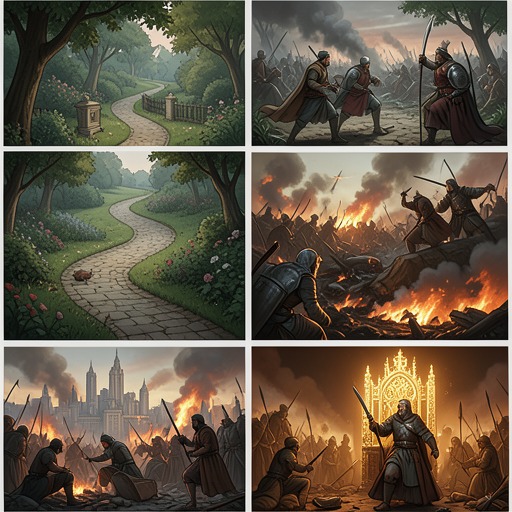
The disaster emerges after humanity’s first violence has expanded into a social order ruled by appetite, pride, and power. The people whom Adam sees have moved from triumph and warfare into pleasure, ease, sloth, excess, lust, and wantonness; peace has not restored virtue but has allowed corruption to spread under conditions of abundance. Justice, temperance, truth, and faith are forgotten. Michael explains that peace can corrupt as thoroughly as war can waste, because prosperity becomes an occasion for indulgence rather than restraint.
Against this world stands Noah, described through the vision as the one righteous man alive. He protests publicly against the prevailing ways, preaching conversion and repentance to people already under imminent judgment. When his warnings are rejected, he withdraws his tents and begins the work commanded by God. His righteousness is therefore represented not as private purity alone but as endurance against custom, ridicule, and the hostility of an entire society.
Noah builds a vessel of enormous size, measured by cubit in length, breadth, and height. He coats it with pitch, constructs a door in its side, and stores abundant provisions for both human beings and animals. The preparations establish the Ark as an instrument of deliberate preservation rather than an improvised refuge: survival depends on obedience, foresight, and the careful gathering of life before judgment arrives.
The Deluge and the Destruction of the Old World
Once Noah, his three sons, their four wives, and the chosen animals are inside, God closes the door. Every kind of beast, bird, and small insect enters in sevens or in pairs according to its order. The scene concentrates the variety of the living world into one protected vessel, making the Ark a compressed remnant of creation amid the disappearance of everything outside it.
The South Wind rises with black wings and drives the clouds together beneath Heaven. Vapors and exhalations rise from the hills; the sky becomes a dark ceiling; and rain falls continuously and violently until the Earth can no longer be seen. The Flood is not a localized inundation but an all-encompassing reversal of the world’s visible structure. The vessel floats above the drowned landscape, while every dwelling and all the former pomp of human civilization are rolled beneath the water.
The waters rise beyond the highest hills. The Flood even dislodges the mountain of Paradise, stripping its vegetation and carrying its trees down the great river toward an opening gulf. The former garden becomes a salt and barren island inhabited by seals, sea-monsters, and sea-mews. This displacement makes a theological point within the event: no location possesses sanctity merely by being a place; sacredness depends on the people who faithfully frequent or inhabit it. The catastrophe consequently destroys not only bodies and buildings but also the presumption that any earthly site can guarantee protection without righteous human presence.
The scale of the destruction overwhelms Adam. He sees the end of all his offspring and experiences his grief as another flood, a flood of tears and sorrow that sinks him as surely as the waters sink his descendants. His foreknowledge becomes a form of suffering: evils belonging to many ages arrive in his mind at once, so that he feels future destruction before the people who will undergo it exist. The event thus has two temporal dimensions, the physical Flood and the anticipatory flood of prophetic knowledge.
Recession, Survival, and the Signs of Renewal
The Flood eventually abates when the clouds flee before a keen North Wind. The Sun dries the surface of the waters, drawing fresh water upward until the standing lake shrinks into a moving ebb and retreats toward the deep. The Ark ceases to float and comes to rest on the summit of a high mountain, while the tops of other hills gradually emerge and the currents drive back toward the sea.
Noah tests the transformed world through a sequence of birds. A raven flies out first; then a dove is sent to search for a place where its foot can rest. The dove returns once and is sent out again, returning the second time with an olive leaf in its bill. The leaf becomes a concrete sign that the waters are falling and that living vegetation has survived. When dry ground appears, Noah descends from the Ark with all his company, and the movement from enclosure to earth marks the passage from mere survival to renewed habitation.
Noah responds to deliverance with uplifted hands and devout eyes. Above him he sees a dewy cloud containing a conspicuous bow with three colors. For Adam, who has been crushed by the destruction of the old world, this sight changes grief into hope. He rejoices that humanity will continue with the creatures and that their seed will be preserved; one perfect and just man has become the source from which God raises another world.
Covenant and the Second Beginning
Michael interprets the rainbow as God’s covenant. Although God has been grieved by a world filled with violence and by flesh corrupting its ways, the presence of one just man leads to mercy rather than total annihilation. God promises never again to destroy the Earth by flood, never to let the sea surpass its bounds, and never again to drown the world’s human beings and animals with rain. Whenever a cloud covers the Earth, the triple-colored bow will recall this promise.
The covenant restores regularity to time as well as security to space. Day and night, seedtime and harvest, heat and hoary frost will continue their courses until fire purges all things anew, after which the just will dwell in a renewed Heaven and Earth. The Flood therefore divides history into two worlds: one begins, becomes corrupt, and ends; another proceeds from Noah as a second stock. The catastrophe is not presented as the final end of creation but as a severe interruption within a larger history of judgment, preservation, and eventual renewal.
Narrative and Thematic Significance
The Flood gives physical form to the poem’s account of moral consequence. Natural forces that had already become disordered through the human Fall—seasonal extremes, violent winds, pestilence, and conflict among animals—now culminate in a world-covering inundation. The disaster is at once meteorological and ethical: rain, broken fountains of the deep, winds, and altered seas perform judgment on a civilization whose violence and excess have made the Earth corrupt.
Yet the event does not reduce nature to scenery. Wind, cloud, Sun, water, mountain, birds, and recovering vegetation each carry the action forward. The environment becomes an agent of destruction and then of communication, first concealing the Earth beneath water and later revealing survival through the olive leaf and the returning ground. The same world that bears the judgment also supplies the means by which life is measured, tested, and restored.
As a vision narrated by Michael to Adam, the Flood functions simultaneously as history, warning, and instruction. Adam learns that violence may be followed not by lasting peace but by renewed corruption, that foreknowledge itself can intensify grief, and that no human civilization is secure when justice and temperance disappear. At the same time, the Ark and the rainbow prevent the vision from ending in despair. The Flood closes one human order, but its final image is covenantal: life leaves the vessel, the Earth reappears, and the future is placed under a promise that judgment will not again take this form.